

The funniest thing about circles is that they don’t exist.
“Continuous” circles, at least.
The circular objects we encounter everywhere are discrete entities with jagged edges. They are “imperfect” from the perspective of a lofty mathematician, but for our humble purposes, they are actual circles—one of these grotesque things:

Since space is everywhere fundamentally discrete, all geometric objects are existing within non-Euclidean space. That makes their properties not easily captured by high school mathematics.
I just want to focus on one idea in discrete geometry: what length is, and by extension what a circumference is, as finitists who reject the notion of “continuity” and “real numbers.”
The first thing to understand is what we’re giving up, by rejecting continuity in geometry. Take this wonderful, intuitive, GIF that demonstrates the relationship between diameter, circumference, and pi.
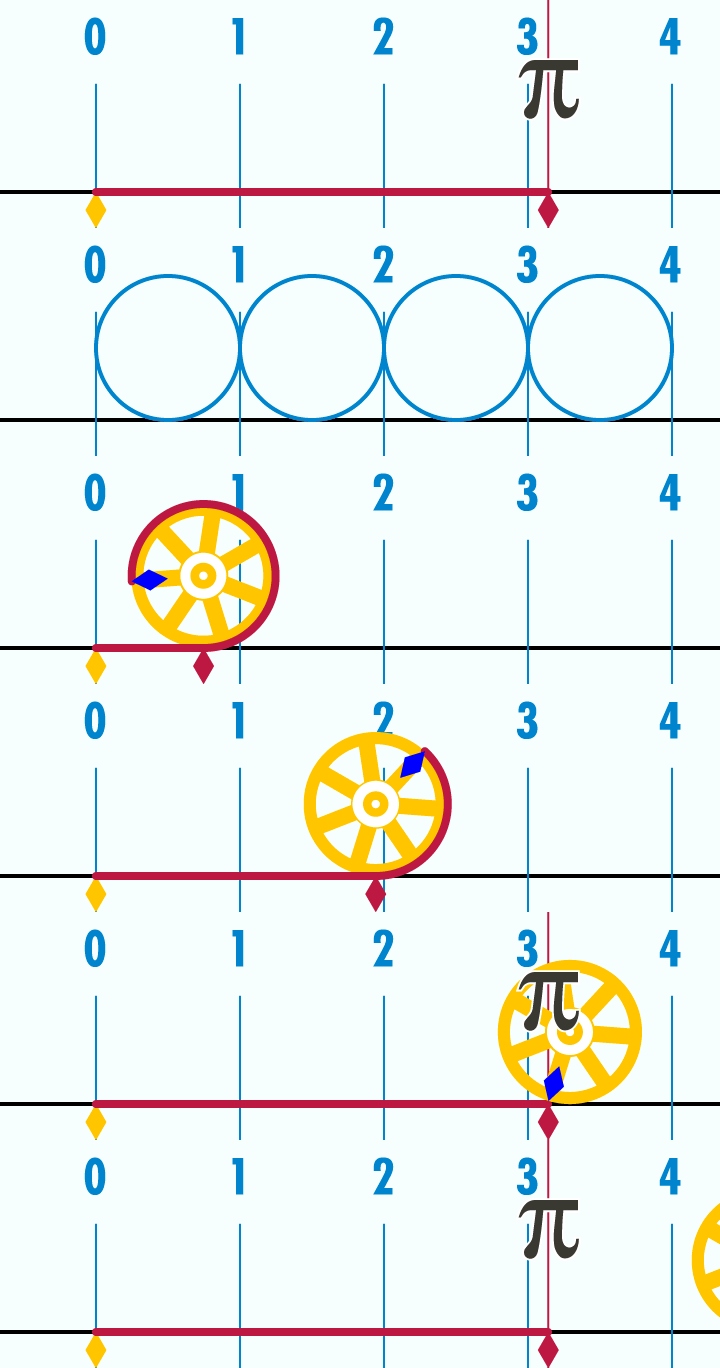
The idea of circumference is that you can “unroll” the “length” of the boundary of the circle. The distance traveled by a rotation of a circular wheel is fundamentally connected to the diameter of the wheel. If the diameter of the wheel is 1, then its circumference is pi—3.14159…
This is all simple, beautiful, and wrong. The GIF is lying.
The first thing to note is that the circumference is fully and completely unrolled on the number line—there is no transcendental pi here. There are a finite number of pixels composing the edge of the wheel and a finite number of pixels composing the “unrolled line”. The ratio of circumference-pixels to diameter-pixels can be expressed by a rational number.
Triangles First
At the surface level, this pixelated geometry approach seems to break our math. For example, if the hypotenuse of a right triangle is simply “the number of pixels which compose it”, then the standard expression of the Pythagorean theorem does not hold—depending on how the lines of the triangle are constructed, c might be equivalent to b (i.e. the hypotenuse and its base have “the same length”), or in the stair-stepper pattern, it might be exactly 2b.
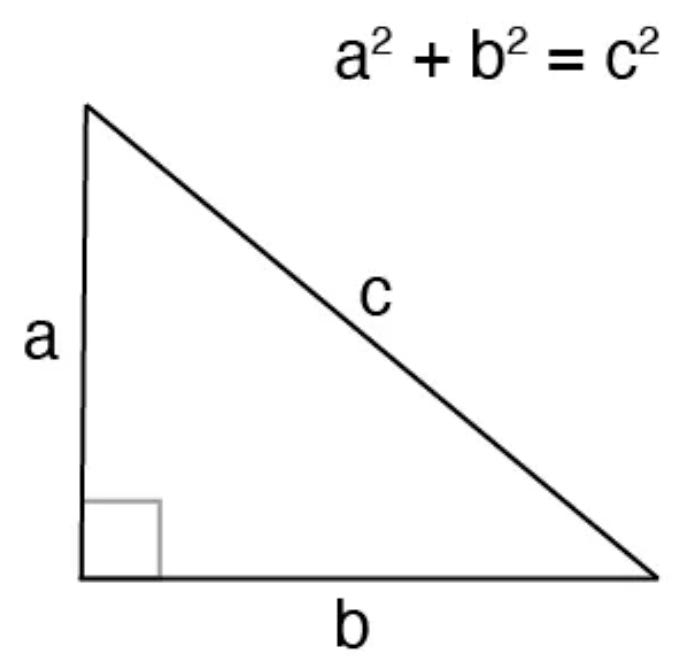
The problem with triangles it the same as the problem with circles. Let me attempt two ways to explain:
Attempt 1
The problem is treating length as dimension-independent—treating “length along A, B, and C” as interchangeable lengths. But if you look closely, there’s something unique about length C which is totally different from lengths A and B.
Think about it in terms of difference. The bottom of Line A is different from the top of Line A along one dimension. The leftmost point of Line B is different from the rightmost point along one dimension. But line C combines these two changes—it’s different along 2 dimensions!
So my claim is that talking about “length” means something different when there is dimensionality (or shape) involved.
The assumption of continuous space discards this information and says A, B, and C’s length-units are all interchangeable. In other words, if A is 3 feet and B is 4 feet, then C is 5 feet. These feet are all interchangeable and have the same meaning—feet are feet!
Attempt 2: Mathspeak
I’m sure there’s a way to encapsulate this idea with mathematical language, but I don’t know enough to be confident. From what I can tell, this is essentially about the question of isotropy versus anisotropy—whether or not a space is uniform in every direction.
1d discrete space might be isotropic, but as soon as we move into two dimensions, it becomes inherently anisotropic, and with anisotropic spaces, we cannot represent length with a simple scalar value. We need higher-dimensional language.
My claim is that isotropy is a mathematical fiction; all isotropic spaces bake in the assumption of continuity. Without continuity, all space is anisotropic.
i.e. real space is discrete space, and discrete space is anisotropic space.
Back to Circles
Returning to our wonderful GIF:
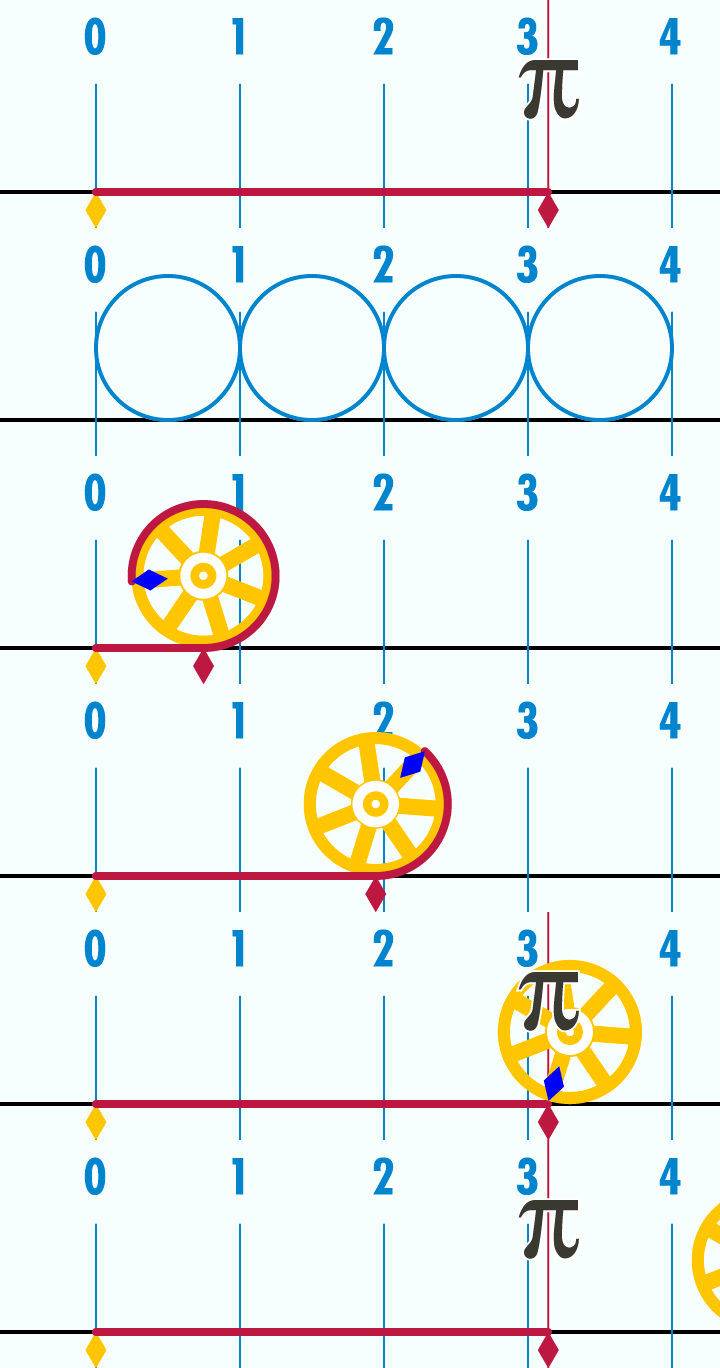
I want to say it’s continuity that is creating all the problems here.
In the standard story, we would say something like “with a perfect circle, the ratio of its circumference to its diameter is irrational, and therefore at a deep level, the notion of ‘length of the diameter’ and ‘length of the circumference’ are incommensurable.”
However, that story does not hold if circles are discrete. By rejecting continuity, the irrationality and incommensurability go away too!
So, there should be a way to meaningfully talk about the ratio of a circle’s circumference to its diameter with total precision—without invoking irrational, real, or transcendental numbers. I don’t yet have the mathematical language to express this, but I know it will look different than simple scalars.
All of this, of course, vindicates one of the criticisms we finitists receive: we have taken a very simple thing and turned it into an incredibly complex thing. But alas, that’s the cost of moving from “good enough, useful, approximate models” to “total logical precision.”
> The funniest thing about circles is that they don’t exist.
Is there a list of Funny Things About Circles showing this aspect as the clear No. 1 rank? Asking for a friend . . .
well written, thank you. also don't miss this guy's riemann visuals https://www.youtube.com/watch?v=9IdkvifRFgU